
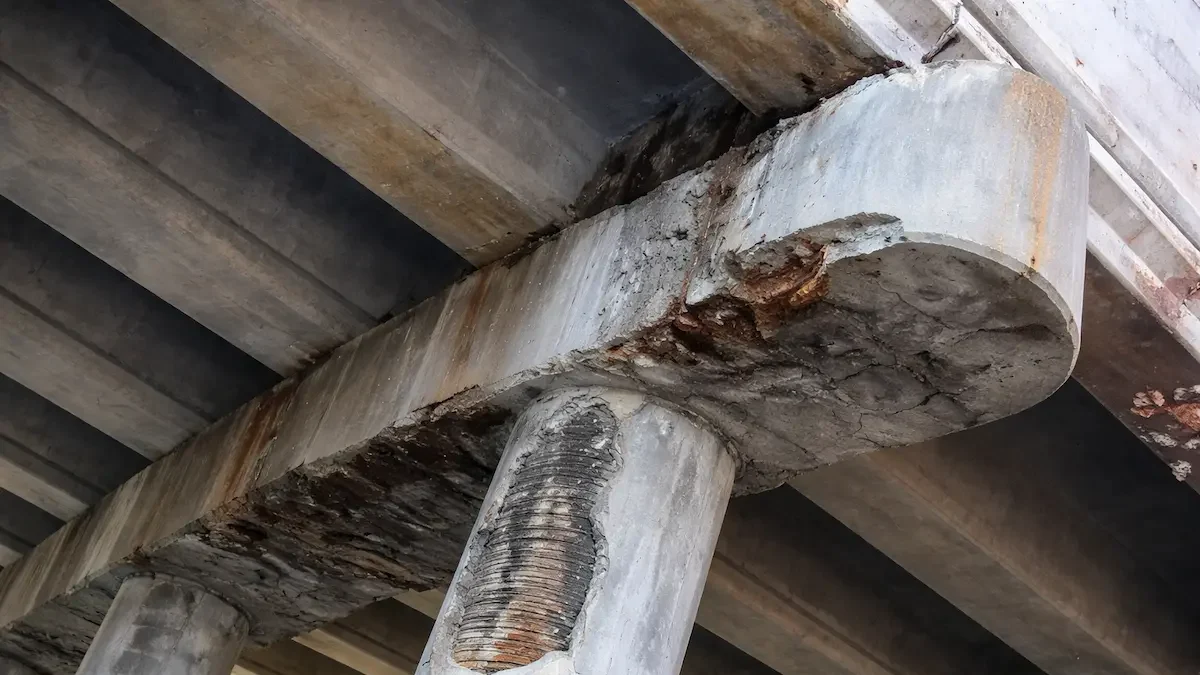
America’s infrastructure funding gap reached $3.7 trillion in 2025. The Highway Trust Fund faces a $33 billion shortfall in 2026 alone. The IIJA — the largest federal infrastructure investment in decades — expires this year. Here is how the US fell so far behind and what happens next.
$3.7T – Infrastructure funding gap through 2033, even at current IIJA spending levels (ASCE 2025 Report Card)
$33B – Projected Highway Trust Fund shortfall in 2026 alone — the year IIJA funding expires (US Chamber of Commerce / CBO)
America’s overall infrastructure grade in 2025 — up from C- in 2021, but stormwater and transit still rated D (ASCE)
According to the American Society of Civil Engineers’ 2025 Infrastructure Report Card, the United States earned an overall grade of C — an improvement from C- in 2021, but one that masks a persistent and widening funding gap. ASCE estimates that $9.1 trillion in infrastructure investment is needed between 2024 and 2033 to improve, modernize, and maintain critical systems. Of that, approximately $5.45 trillion in public and private investment has been outlined — leaving a funding gap of at least $3.7 trillion. Stormwater and transit systems remain rated D. Roads, levees, schools, and wastewater facilities posted only marginal gains. The improvements that do exist are largely the product of the Infrastructure Investment and Jobs Act, a law whose funding authorization expires at the end of 2026.
How the Highway Trust Fund Ran Dry
The structural problem at the core of US infrastructure underinvestment is the Highway Trust Fund, the federal mechanism that finances roads, bridges, and transit since the Eisenhower era. The HTF is funded by the federal gasoline tax — 18.4 cents per gallon, unchanged since 1993. That rate has not kept pace with inflation, construction costs, or vehicle technology. As the US Chamber of Commerce noted in February 2026, more fuel-efficient, hybrid, and electric vehicles are paying far less — or nothing — into the HTF while relying on the same road network. The Congressional Budget Office now projects a $33 billion shortfall in the HTF in 2026 alone. Without congressional action to reauthorize and fund the next surface transportation bill, states and local governments cannot maintain these networks independently.
The IIJA’s Unfinished Business
The Infrastructure Investment and Jobs Act, signed in November 2021, authorized $1.2 trillion in total spending — the largest federal infrastructure investment in decades. As of late 2024, more than $568 billion had been allocated toward 66,000 state-level projects spanning roads, bridges, broadband, water systems, and EV charging infrastructure. The law produced measurable gains: the ASCE’s improved national grade reflects in part those investments beginning to reach construction. But the gains are uneven. Urban Institute analysis published in November 2025 found that the IIJA’s increased spending was concentrated among highway projects, while overall public transit capital spending flatlined and rail projects saw a net decline. The law expires in 2026, and Congress has not yet passed a successor.
States Are Already Falling Further Behind
Even before the IIJA expiry, states were not keeping pace with their own road and bridge maintenance needs. Pew Charitable Trusts analysis published in February 2026 found that aggregate state investment in existing roadway assets, given current policies, will not keep pace with needs. The combined funding adequacy index for pavement and bridges across the 25 states studied will drop from 78 percent in year one to 65 percent by year ten. The annual pavement shortfall alone is projected to rise from $2.1 billion to $3.7 billion over that period. Of the 25 states analyzed, 24 reported funding gaps for roads, bridges, or both totaling $86.3 billion over ten years.
Sector-by-Sector: Where the Gaps Are Largest
| Sector | ASCE Grade | Estimated Gap Through 2033 |
|---|---|---|
| Roads | D+ | $684 billion; $2.2 trillion total investment needed |
| Energy / grid | D+ | Nearly $1.9 trillion; demand could rise 47% by 2040 |
| Stormwater | D | $690 billion — highest single-sector gap |
| Transit | D | Flatlined capital spending; significant deferred maintenance |
| Bridges | C+ | 221,800 bridges need repair or replacement; funding adequacy declining |
| Ports | B | Highest-graded sector; improvements sustained by IIJA port investments |
What Happens When the IIJA Expires in 2026
- $492 billion in remaining IIJA fundingmust be allocated by the end of 2026 — with agencies prioritizing preservation of existing assets over expansion as the deadline approaches
- Congress must pass a new surface transportation billto replace the IIJA; without it, states lose the federal framework that governs road and bridge spending — a scenario the US Chamber called a direct threat to economic growth
- Workforce shortagesare compounding the funding problem: ASCE found persistent gaps across engineering, construction, and inspection roles that slow project delivery even when money is available
- Each household loses an estimated $3,400 annuallyin economic costs from infrastructure deficiencies, including vehicle damage, congestion delays, and reduced productivity, according to ASCE modelling