
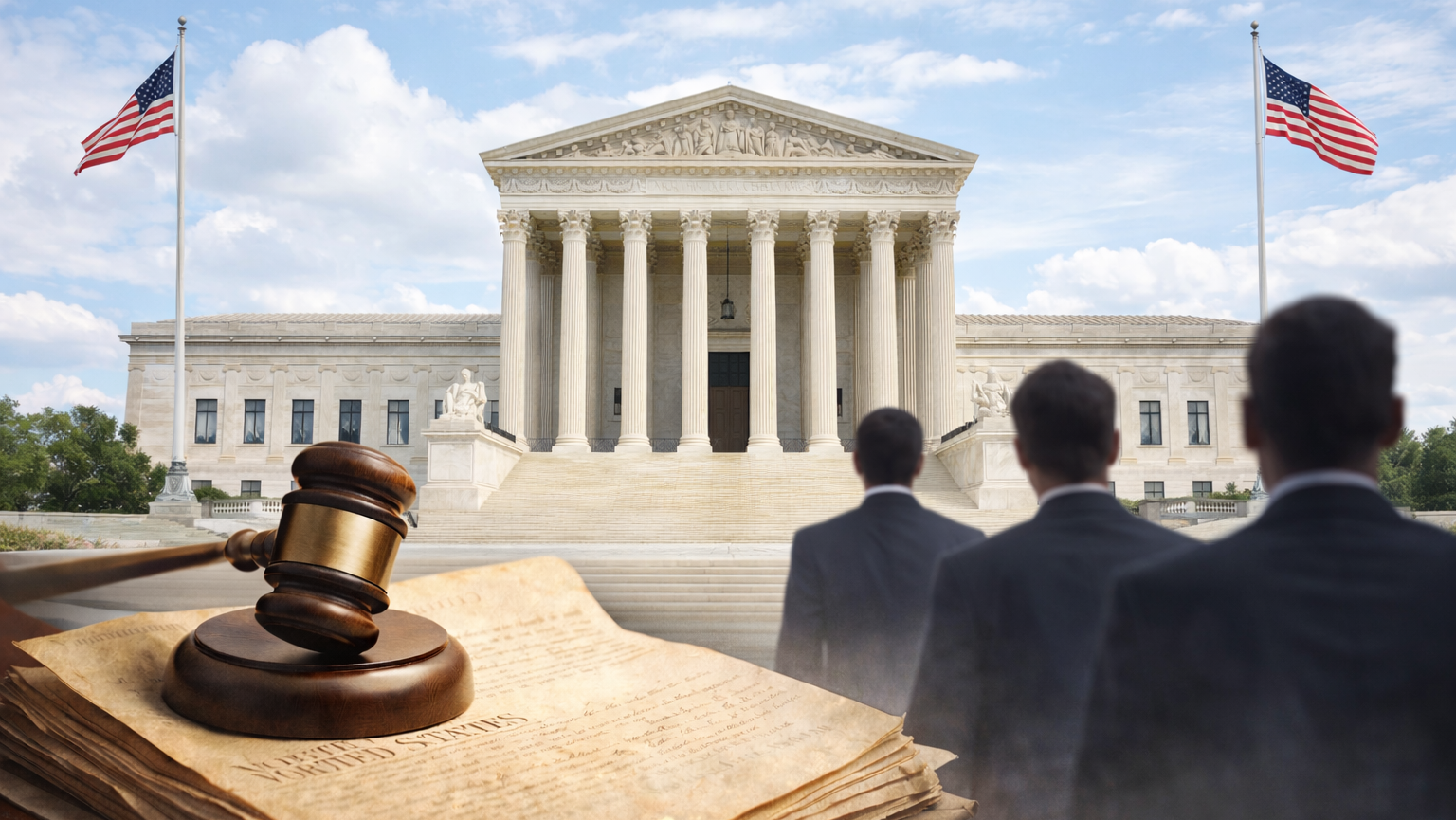
Just days ago, nine unelected judges overruled the President of the United States — and there was nothing he could do about it. On February 20, the Supreme Court struck down Trump’s sweeping tariffs in a 6-3 ruling, with two of his own appointees siding against him. Trump called it “deeply disappointing.” The episode raises a question most Americans never stop to think about: where does the Supreme Court actually get this kind of power — and is it too much for any democracy to hand to nine people nobody voted for?
The Constitution Is Surprisingly Vague About It
The Supreme Court’s authority isn’t spelled out the way most people assume. Article III of the Constitution establishes a federal judiciary and gives the Court jurisdiction over certain cases — but it says almost nothing about what the Court can actually do with that jurisdiction.
The Court’s most important power — striking down laws passed by Congress or actions taken by the president — isn’t written in the Constitution at all. The Court claimed it for itself. In the 1803 case Marbury v. Madison, Chief Justice John Marshall declared it was “the province and duty of the judicial department to say what the law is.” That single sentence created judicial review: the authority to declare any law or executive action unconstitutional. Congress never voted on it. No amendment was passed. The Court simply decided it had the power — and nobody successfully challenged that claim in over 200 years.
Lifetime Appointments and Zero Accountability
The controversy around the Supreme Court runs deeper than any single ruling. It’s structural. The president nominates justices, the Senate confirms them, and once confirmed, they serve for life. There is no mandatory retirement age. Removing a justice requires impeachment — which has happened once in U.S. history and ended in acquittal.
This means a single president with a cooperative Senate can reshape American law for decades. Trump appointed three justices in his first term — Gorsuch, Kavanaugh, and Barrett — locking in a 6-3 conservative majority. In the February 20 tariff case, Gorsuch and Barrett both voted against him. Trump publicly condemned their votes — which only underscored the point: lifetime tenure means justices answer to no one once confirmed, not even the president who put them there.
The Major Questions Doctrine: The Court’s Biggest Power Grab in Decades
In recent years, the Court has quietly expanded its own reach through a legal principle called the major questions doctrine. The rule holds that when the executive branch claims sweeping power over a major political or economic issue, it must point to explicit congressional authorization — not a vague or implied grant of authority.
As SCOTUSblog reported, Chief Justice Roberts wrote for the majority in the tariff case that Trump was asserting “the extraordinary power to unilaterally impose tariffs of unlimited amount, duration, and scope” — exactly the kind of major question requiring clear congressional approval. The Tax Foundation estimates the struck-down tariffs would have cost American households $1.4 trillion through 2035. The doctrine has now been used to block Biden’s student loan plan, his vaccine mandate for 84 million workers, and Trump’s trade agenda — giving the Court effective veto power over the boldest moves of any administration.
Why Public Trust Has Collapsed
Gallup polling has shown trust in the Supreme Court near historic lows in recent years. Critics on the left point to the 2022 decision overturning Roe v. Wade as proof of a politically captured institution rewriting settled precedent overnight. Critics on the right point to decades of rulings they say strayed far beyond anything the Constitution’s text supports.
What both sides increasingly agree on is the underlying tension: in a democracy, the most powerful court in the country is made up of nine unelected people, appointed for life, accountable to no voter, with the power to override elected branches whenever five justices decide the law requires it. Whether that’s a feature or a flaw depends entirely on whose agenda the Court is blocking.
📩 If you noticed an error or have a tip, please contact us via our Contact page.