
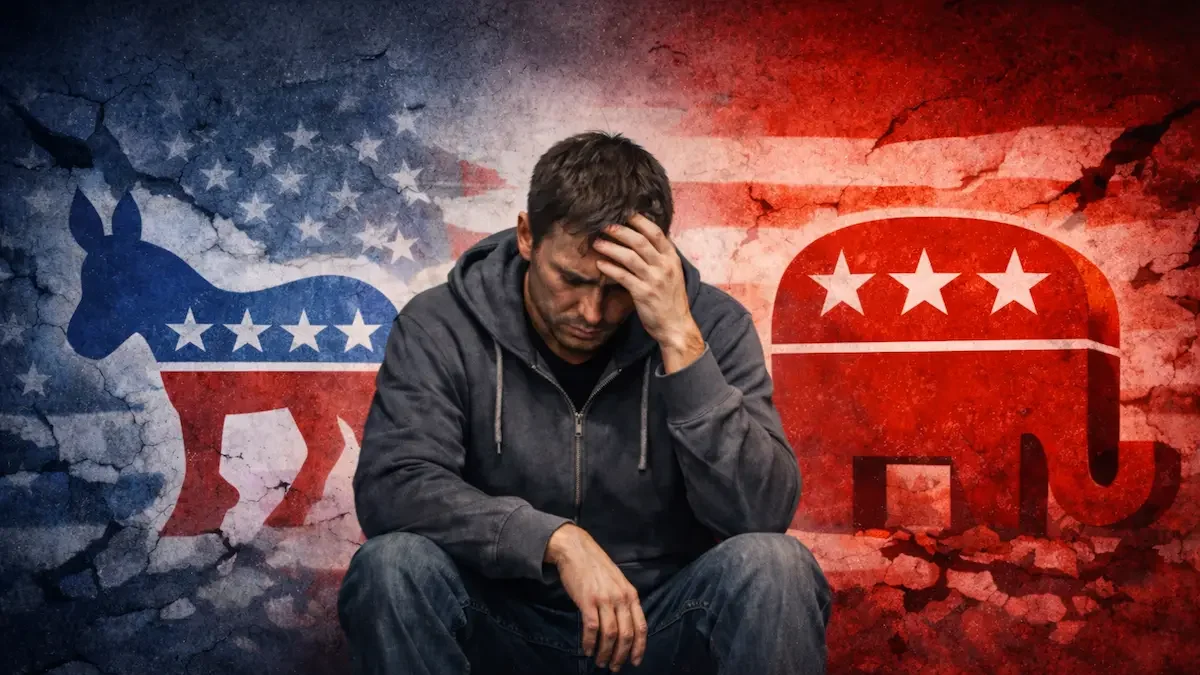
Independent voters in 2026 now make up 45 percent of American adults — an all-time Gallup high. They outnumber both Democrats and Republicans, they swung the 2024 election, and millions cannot vote in the primaries that actually decide most races.
45% -Americans identifying as independents — all-time Gallup high (2025)
34% -Independent share of 2024 electorate — tied with Republicans, ahead of Democrats at 32% (Edison Research)
23.5M -Independent voters excluded from primaries in 37 states with closed or semi-closed rules (Unite America)
Independent voters in 2026 are the largest and fastest-growing segment of the American electorate. Gallup found that 45 percent of U.S. adults identified as independents in 2025 — an all-time high. An NBC News analysis of voter rolls found unaffiliated voters now make up 32 percent of registered voters, up from 23 percent in 2000, with younger voters driving most of the growth. The shift has been accelerating since 2010, with each wave of disillusioned party members — from Tea Party-era Republicans to progressive Democrats — adding to an independent bloc that now outnumbers either major party by a significant margin.
Who Independent Voters in 2026 Actually Are
The group is ideologically diverse but internally cohesive. A Unite America survey across 20 states found independents identify overwhelmingly as moderate and split their trust by issue — leaning toward Democrats on abortion and healthcare, toward Republicans on the economy and immigration. Despite that spread, the Independent Center’s AI-driven modeling found they share a consistent skepticism of the partisan system itself — a cohesion that is attitudinal rather than ideological. Among Gen Z, 56 percent identify as independent according to Gallup; 54 percent of Millennials do the same. Voters over 65 remain the group most likely to hold a major-party registration, and they are the only age cohort where party affiliation has not declined over the past decade.
The Primary Problem: Independent Voters Locked Out
Despite their size, independent voters face a structural barrier. Fifteen states hold closed congressional primaries; 22 do so for presidential contests. Unite America found that these rules exclude more than 23.5 million voters from the stage at which most safe-district outcomes are decided. In 2024, just 7 percent of voters determined 87 percent of US House seats. The consequence is a nomination system that systematically filters out candidates who might appeal to the middle — producing nominees who are well-positioned for the primary and poorly positioned for the general. The debate over reform is live in 2026: Texas Republicans have filed a federal lawsuit to close their open primary; New Mexico enacted legislation in 2025 opening its primary to unaffiliated voters without requiring a registration change.
| Indicator | Data | Source |
|---|---|---|
| Adults identifying as independent | 45% — all-time high | Gallup, 2025 |
| Registered unaffiliated | ~32% of voters; 33.7M total | Ballotpedia / NBC News |
| 2024 electorate share | 34% — tied Republicans, ahead of Democrats (32%) | Edison Research |
| Excluded from primaries | 23.5M shut out of closed-state primaries | Unite America |
| Pure vs leaners | 48% pure; 27% lean Democrat; 25% lean Republican | Unite America survey |
What the Rise of Independent Voters Means for Both Parties
AEI’s December 2025 analysis identified a structural driver: both parties have become mirror images — support for Trump is the Republican litmus test; resistance to Trump performs the same function for Democrats. Voters who fit neither frame are leaving affiliation behind without leaving politics. For Democrats, the challenge is that those who swung Republican in 2024 did so on economic grounds that have not improved. For Republicans, a closed primary system increasingly produces nominees optimised for a shrinking base while the general electorate continues to grow less partisan. Both parties face a version of the same trap: the nomination process rewards ideological purity, while winning a general election in a competitive district increasingly requires carrying a majority of voters who belong to neither party.
Key Dynamics — November 2026
- Independent turnout surpassed Democrats for the first time in 2024, per CNN exit polling — these voters are no longer a low-propensity afterthought
- Battleground statesincluding Arizona, Nevada, Pennsylvania, and Wisconsin will likely be decided by unaffiliated voter performance
- Economic dissatisfactiondrives independent voters: they trust Republicans more on the economy, Democrats more on healthcare — a split-ticket opportunity for candidates who break from orthodoxy
- Primary reformis under active discussion: Alaska-style open ranked-choice and top-two systems are on several state agendas
The 2026 midterms are the first electoral test of whether either party can build a coalition that addresses this growing bloc rather than treating it as a residual category. For related coverage, see our analysis of why bipartisan legislation has become so rare and how rising local election turnout is reshaping national politics.